What Are the Most Dangerous Intersections in Phoenix?
Your safety shouldn't depend on the luck of a green light.
But in Phoenix, some intersections are so dangerous, a routine drive can end in life-altering injury. Whether it's a T-bone crash from a red-light runner or a high-speed pileup during a left turn, intersection collisions are among the most violent and deadly on Arizona roads.
Using the latest crash data from the Maricopa Association of Governments (MAG) and the Arizona Department of Transportation (ADOT), we break down the top 10 most dangerous intersections in Phoenix, what causes them, and how we help clients recover after life-changing accidents.
By the Numbers: Intersection Crash Trends in Phoenix
Phoenix drivers were involved in more than 36,000 crashes in 2023 - and a large share of them happened at major intersections.
- 38,331 crashes in 2022
- 36,927 crashes in 2023
- 37,472 crashes in 2024 (preliminary count)
These incidents come at a steep cost. In 2023 alone, crashes in Maricopa County resulted in an estimated more than $12.5 billion in economic losses, including medical bills, lost productivity, and property damage. That figure remained high in 2024, with over $11.8 billion in estimated losses.
While crashes can happen anywhere, MAG data shows that certain intersections consistently report higher crash volumes, more injuries, and costlier outcomes. Understanding these patterns is the first step toward prevention, and accountability.
The Top 10 Most Dangerous Intersections in Phoenix
Based on a five-year study from the Maricopa Association of Governments (MAG), these are the Phoenix intersections with the highest combined crash frequency, injury severity, and crash-related costs.
MAG's Final Risk Score blends those three factors into a single number — so this list doesn't just show where crashes are most common, but where they tend to be most serious.
Highest-Risk Intersections in Phoenix (2018–2022)
| Rank | Intersection | Total Crashes | MAG Final Risk Score |
|---|---|---|---|
| 1 | 67th Ave & McDowell Rd | 229 | 0.886 |
| 2 | 51st Ave & Camelback Rd | 174 | 0.755 |
| 3 | 19th Ave & Peoria Ave | 105 | 0.660 |
| 4 | 67th Ave & Thomas Rd | 128 | 0.638 |
| 5 | 67th Ave & Indian School Rd | 256 | 0.629 |
| 6 | 83rd Ave & Indian School Rd | 187 | 0.618 |
| 7 | Cave Creek Rd & Sweetwater Ave | 46 | 0.614 |
| 8 | 51st Ave & Thomas Rd | 181 | 0.611 |
| 9 | 27th Ave & Camelback Rd | 206 | 0.596 |
| 10 | 99th Ave & Lower Buckeye Rd | 429 | 0.574 |
Key Takeaways:
- 99th Ave & Lower Buckeye Rd had the most crashes overall — more than any other intersection in the study.
- 67th Avenue appears three times in the top five, highlighting it as one of the most crash-prone corridors in the city.
- Cave Creek Rd & Sweetwater Ave made the top 10 despite having just 46 crashes — a sign that the crashes there tend to be more severe.
Spotlight on the Most Dangerous Intersection in Phoenix
67th Avenue & McDowell Road
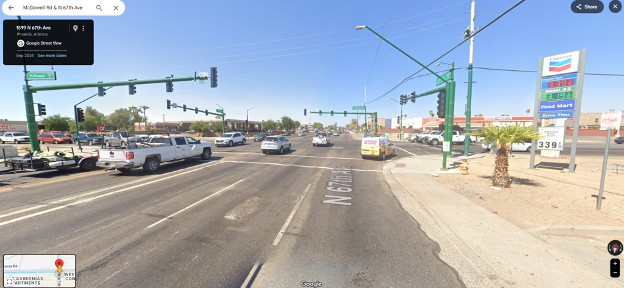
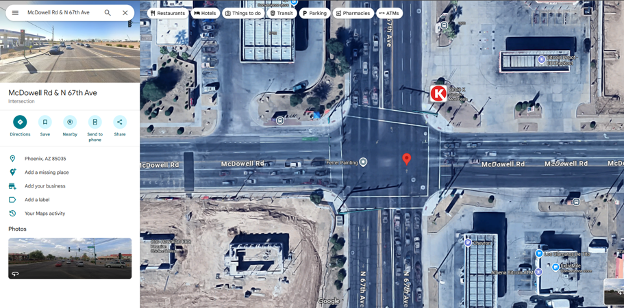
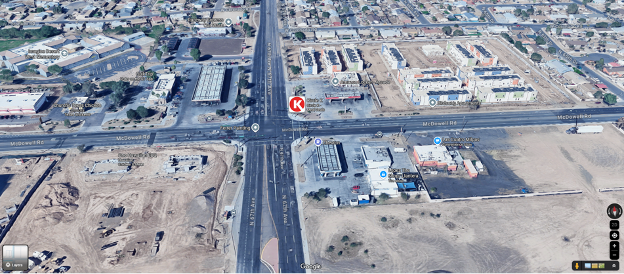
According to MAG's five-year crash analysis, 67th Ave & McDowell Rd is the highest-risk intersection in Phoenix.
Between 2018 and 2022, it saw:
- 229 total crashes
- Final risk score: 0.886 - the highest of any intersection in the study
This intersection is located in West Phoenix, just south of I-10, in a heavily traveled commercial corridor with multiple gas stations, fast food entrances, and retail access points near the corners.
What makes it so dangerous:
- Wide arterial design with multiple turn lanes and high-speed through traffic
- Channelized right turns that allow vehicles to roll through without stopping
- Frequent red-light violations and sudden left turns across traffic
- Driveway congestion, especially during rush hours and weekends
The combination of speed, complexity, and commercial density creates dozens of conflict points for drivers, increasing the risk of T-bone, rear-end, and turning collisions.
If your crash happened at this intersection, or another like it, Ramos Law can help you investigate the cause, prove fault, and build a claim that reflects the full impact of your injuries.
Why These Intersections Are So Dangerous
Not all crashes are created equal, and not all intersections pose the same level of risk.
To understand which intersections are truly the most hazardous, the Maricopa Association of Governments (MAG) uses a detailed formula called the Network Screening Methodology for Intersections (NSM-I). This system doesn't just tally crash volume. It evaluates:
| Component | What It Measures | Weight in Final Score |
|---|---|---|
| Crash Frequency (CF) | How many crashes occurred at the intersection over five years | 25% |
| Crash Severity (CS) | How serious those crashes were, using injury severity weights (e.g., Fatal = 1,450; Incapacitating = 100) | 50% |
| Crash Type (CT) | The average economic cost of each crash, based on its type (e.g., T-bone vs. rear-end) | 25% |
The result is a Final Intersection Safety Score (ISS) calculated as:
Why That Matters in Phoenix
This method explains why some intersections rise to the top of the danger list, even if they don't have the most crashes overall.
High-volume intersections
Locations like 99th Ave & Lower Buckeye Rd earn high scores because of sheer crash volume. This location had 429 crashes in five years, more than any other Phoenix intersection.
High-severity locations
Locations like Cave Creek Rd & Sweetwater Ave rank in the top 10 despite just 46 crashes. That's because many of those collisions involved serious injuries. MAG uses a weighted system (KABCO scale), where a fatal crash counts 1,450 times more than a property-damage-only crash.
Crash type matters too
T-bone and head-on collisions carry an average cost of $34,000–$81,000 per vehicle, far exceeding rear-end crashes. Intersections with more of these high-impact crash types rank higher in risk, even if they see fewer fender benders overall.
Common Risk Patterns in Phoenix's Highest-Ranked Intersections
Across the top 10 intersections, MAG data and on-the-ground imagery reveal consistent patterns:
- T-bone crashes at fast, multi-lane left-turn zones
- Channelized right turns and high-speed through movements
- Poor visibility or visual clutter (gas station signs, uneven pavement)
- Nearby commercial driveways, creating sudden merging and lane changes
- Speeding or red-light running, especially during off-peak hours
That's why locations like 67th Ave & McDowell Rd, which appears in three of the top five rankings, stand out. They don't just have frequent crashes. They combine complex traffic patterns, fast-moving vehicles, and vulnerable road users in one high-risk zone.
When those factors add up, even one intersection can become the site of dozens of serious injuries in just a few years.
Phoenix Intersections with the Most Crashes Overall
Some intersections rank high on risk because of injury severity or crash type. Others land at the top simply because crashes happen there more often than anywhere else.
Based on total reported crashes from 2018 to 2022, these Phoenix intersections saw the highest raw crash counts, regardless of severity:

| Rank by Crash Volume | Intersection | Total Crashes |
|---|---|---|
| 1 | 99th Ave & Lower Buckeye Rd | 429 |
| 2 | 67th Ave & Indian School Rd | 256 |
| 3 | 75th Ave & Indian School Rd | 224 |
| 4 | 75th Ave & McDowell Rd | 224 |
| 5 | 67th Ave & McDowell Rd | 229 |
| 6 | 27th Ave & Camelback Rd | 206 |
| 7 | 51st Ave & Indian School Rd | 186 |
| 8 | 43rd Ave & McDowell Rd | 191 |
| 9 | 83rd Ave & Indian School Rd | 187 |
| 10 | 51st Ave & Thomas Rd | 181 |
What These Numbers Show
- 99th Ave & Lower Buckeye Rd had the highest number of crashes in the entire MAG region, almost twice as many as any other top-10 intersection.
- Indian School Road appears in four of the top ten locations, confirming its role as one of the busiest and most crash-prone roads in the city.
- Most of these intersections are located in the West Valley, where wide roads, high traffic volumes, and complex turning patterns contribute to frequent collisions.
- Even if not all of these crashes result in serious injury, high-frequency intersections increase the day-to-day risk for drivers, pedestrians, and cyclists who use them regularly.
The Most Dangerous Corridors in Phoenix
While some intersections stand out on their own, others are part of larger high-risk stretches of road. When multiple dangerous intersections line the same corridor, it signals a deeper traffic safety issue, one that impacts drivers mile after mile.
MAG's crash data shows several Phoenix roadways that appear again and again in the city's top 100 intersection rankings.
67th Avenue (West Phoenix)
Appears 3 times in the top 5:
- 67th Ave & McDowell Rd (#1)
- 67th Ave & Thomas Rd (#4)
- 67th Ave & Indian School Rd (#5)
This corridor runs through densely developed neighborhoods with wide arterials, heavy left-turn volumes, and frequent driveways near intersections.
Pattern: Multi-lane speed, commercial traffic, and complex turn patterns.
Indian School Road
Appears in at least 6 high-ranking intersections:
- 67th Ave, 75th Ave, 83rd Ave, 43rd Ave, 59th Ave, and 51st Ave
Known for being a major east-west commuter route, often with high speeds and aggressive turning movements.
Pattern: Cross-traffic crashes and high left-turn volumes in mixed commercial-residential zones.
McDowell Road
At least 6 intersections in the top 50 involve McDowell Rd, including:
- 67th Ave, 75th Ave, 51st Ave, 43rd Ave, 24th St, and 52nd St
Like Indian School, McDowell serves as a key arterial with frequent traffic light stops and wide turning radii.
Pattern: Driveway congestion + speed = layered crash risk.
Why These Corridors Matter
When you see the same road show up repeatedly in crash data, it's a sign of a systemic issue, not just driver behavior, but road design, land use, and enforcement gaps.
If you drive these corridors daily, you're at higher statistical risk, even if you follow the rules. And if you've been in a crash at one of these locations, MAG data may help support your legal case by showing a documented pattern of danger.
The Leading Causes of Intersection Crashes in Phoenix
Behind every intersection crash is a driver decision. And in Phoenix, the data shows that many of these collisions are caused by avoidable violations.
According to the Arizona Department of Transportation (ADOT), these are the top contributing factors in urban crashes involving intersections:
Red-Light Violations
In 2023, more than 5,800 crashes statewide were caused by drivers who ran a red light. Preliminary data from 2024 shows over 5,300 red-light crashes already on record.
These incidents often result in side-impact collisions, where one driver enters the intersection at full speed while another is making a legal movement through the intersection. The outcome is often serious injury.
Failure to Yield the Right of Way
In 2023, over 22,500 crashes involved a driver who failed to yield. This is one of the most common violations at intersections, especially when drivers attempt unprotected left turns across oncoming traffic.
These crashes frequently lead to T-bone or angled impacts, which carry a higher risk of injury due to limited side protection in most vehicles.
Distracted or Impaired Driving
While harder to quantify directly in the data, distracted and impaired driving remain consistent contributors to serious intersection collisions. These behaviors reduce reaction time and increase the chance of missing traffic signals or failing to judge distance and speed accurately.
Why These Causes Matter
Crashes at intersections are rarely random. They often involve a clear traffic violation that puts other drivers at risk.
When a crash happens because someone ignored a red light, misjudged a turn, or drove while distracted, the consequences can be severe. These are the kinds of factors that not only explain how a crash occurred but also form the foundation for proving liability in a legal case.
How Ramos Law Fights for Victims of Intersection Crashes
Intersection crashes are complex. They often involve multiple vehicles, conflicting witness accounts, and unclear fault. That's where legal experience and technical knowledge make the difference.
At Ramos Law, we bring a unique combination of legal strategy, medical insight, and crash reconstruction support to every intersection case.
What Sets Our Approach Apart
We understand injury severity
Because our firm is built around attorneys with medical training, we know how serious intersection crash injuries can be. We work with treating doctors, orthopedic specialists, and neurologists to document the full impact on your life — not just what shows up in the ER.
We work with traffic engineers and crash investigators
When fault is disputed, we bring in independent experts who analyze timing diagrams, vehicle trajectories, and point-of-impact evidence. That means we can prove what happened and why.
We handle complex, multi-vehicle claims
T-bone crashes, left-turn collisions, and red-light impacts often involve more than two vehicles. We coordinate with insurance adjusters, medical providers, and expert witnesses to hold the right parties accountable.
We know the roads
From 67th Avenue to McDowell Road, we know which Phoenix intersections carry the highest risk. We use MAG and ADOT data to support your claim with hard evidence.
If your crash happened at a high-risk intersection, your injuries may not be typical, and your legal team shouldn't be either.