FAA Vision Requirements for Pilot Medical Certification
Flying an aircraft requires sharp focus, quick decision-making and the ability to read instruments, traffic and terrain clearly. Because of this, the Federal Aviation Administration (FAA) has specific vision standards that pilots must meet in order to receive a medical certificate.
Whether you’re an airline captain, a private pilot or someone just beginning flight training, understanding these requirements is essential. If your vision changes or if a medical certificate is denied due to vision concerns, it can affect your ability to legally fly.
At Ramos Law’s aviation division, we regularly help pilots navigate the medical certification process and address aviation-related legal issues tied to medical qualifications.
Vision Requirements by Certificate Class
| Vision Type | First-Class (ATP) | Second-Class (Commercial) | Third-Class (Private) |
| Distant Vision | 20/20 or better in each eye separately, with or without correction | Same as First Class | 20/40 or better in each eye separately, with or without correction |
| Intermediate Vision | 20/40 or better in each eye separately (at age 50+), measured at 32 inches | Same as First Class | No requirement |
| Near Vision | 20/40 or better in each eye separately, measured at 16 inches | Same as First Class | Same as First Class |
| Color Vision | Ability to perceive colors necessary for safe performance of airman duties | Same as First Class | Same as First Class |
FAA Vision Requirements for Pilots
The vision standards set by the Federal Aviation Administration ensure that pilots have the visual acuity necessary to safely operate an aircraft. These requirements vary depending on the class of medical certificate a pilot holds and are designed to ensure pilots can clearly see aircraft traffic, cockpit instruments, navigation charts and runway environments.
The FAA periodically updates medical certification guidance through its Aviation Medical Examiner (AME) Guide.
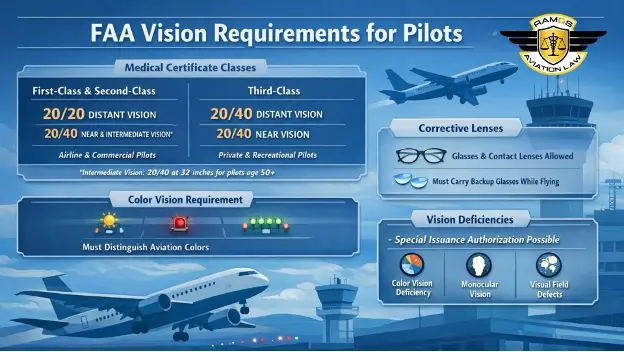
First-Class and Second-Class Medical Certificates
Pilots applying for a First-Class Medical Certificate (required for airline transport pilots) or a Second-Class Medical Certificate (required for commercial pilots) must meet the following vision standards:
- Distant Vision: 20/20 in each eye, with or without corrective lenses
- Near Vision: 20/40 at 16 inches, with or without corrective lenses
- Intermediate Vision: 20/40 at 32 inches for pilots age 50 or older
These requirements ensure that professional pilots can clearly see distant aircraft, read cockpit instruments and interact with modern flight displays positioned at intermediate distances.
Third-Class Medical Certificates
Pilots seeking a Third-Class Medical Certificate, which is required for private and recreational flying, must meet slightly less strict standards:
- Distant Vision: At least 20/40 in each eye, with or without corrective lenses
- Near Vision: 20/40 at 16 inches
Unlike higher certification classes, there is no intermediate vision requirement for third-class medical certificates.
Get Legal Guidance
FAA Near Vision Requirements Requirements
Near vision measures the ability to read instruments, charts and electronic displays inside the cockpit.
For all classes of medical certificates, pilots must have: 20/40 near vision at 16 inches, with or without corrective lenses.
This requirement ensures pilots can clearly read gauges, flight management systems and navigation information.
FAA Intermediate Vision Requirements
Intermediate vision becomes increasingly important with modern cockpit displays.
For First- and Second-Class pilots age 50 and older, the FAA requires: 20/40 intermediate vision at 32 inches, with or without correction.
This distance roughly corresponds to the location of many cockpit displays in transport-category aircraft.
Color Vision Requirements
Pilots must be able to perceive colors necessary for safe performance of airman duties.
This is important for recognizing:
- Aviation chart symbols
- Cockpit warning lights
- Air traffic control signals
- Runway and approach lighting systems
If a pilot fails the initial color vision screening, additional testing may be available to demonstrate adequate color perception.
What If You Need Glasses or Contact Lenses?
Many pilots fly safely while wearing corrective lenses. The FAA allows glasses or contacts to meet the vision standard.
However, pilots may receive a medical certificate restriction that states:
- “Must wear corrective lenses.”
Pilots should also carry a backup pair of glasses while flying in case their primary pair becomes damaged or lost.
When Vision Issues Can Affect Your Medical Certificate
Certain eye conditions may affect eligibility for an FAA medical certificate, including:
- Severe vision loss in one eye
- Progressive eye diseases
- Double vision (diplopia)
- Certain retinal conditions
- Uncorrectable vision impairment
In some situations, pilots may still qualify through a Special Issuance Authorization or Statement of Demonstrated Ability from the FAA after additional medical evaluation.
Legal Help for Pilots Facing Medical Certification Issues
Vision-related medical denials or certification complications can create serious career consequences for pilots. The aviation attorneys at Ramos Law understand how FAA medical certification works and how regulatory decisions can impact pilots, aviation professionals and aircraft operators.
Our aviation team helps pilots with:
- FAA medical certification
- Special Issuance Authorization medical applications
- Regulatory compliance issues
- Aviation accident investigations
- Pilot rights and professional licensing concerns
Talk to an Aviation Attorney at Ramos Law
If you are dealing with FAA medical certification challenges or have questions about aviation regulations, the aviation division at Ramos Law can help you understand your options. Our team combines legal experience with deep aviation knowledge to advocate for pilots and aviation professionals across the country.
Contact Ramos Law today to speak with an aviation attorney about your case.
Experts in Aviation Law
Pilot Certificate Defense
FAA Medical Denial
Aircraft Crashes
FAA DUI Reporting
Civil Penalties
NTSB Appeals
And More!



A Layperson’s Guide to Aviation Law in Arizona
While aviation law may seem like a niche area, its impact stretches far beyond pilots. Understanding aviation law can be especially useful for anyone involved in personal air travel or

Navigating the Skies, Insights from Aviation Law Experts
Navigating Aviation Law: Essential Advice from Legal Experts In this episode of The Difference Makers Podcast, aviation experts Joseph LoRusso, Matthew Bulow, and Ezekiel Denison, from Ramos Law, dive into
FAA Vision Requirements for Pilots: Frequently Asked Questions
How will corrective eye surgery affect my FAA medical certificate?
Pilots who undergo refractive eye surgery (such as LASIK, PRK or SMILE) may still qualify for an FAA medical certificate once their vision stabilizes. The Federal Aviation Administration generally requires:
- Documentation showing stable visual acuity that meets FAA standards for the pilot’s certificate class
- No significant complications or adverse effects from the surgery
- Additional evaluation if complications occur
After surgery, pilots must:
- Be recertified by an Aviation Medical Examiner (AME)
- Carry backup glasses while flying in case of unexpected vision changes
- Report any post-surgical vision changes to their AME immediately
The FAA may temporarily restrict a medical certificate while monitoring vision stability after surgery.
What are the requirements for contact lens use by pilots?
Lack of communication leads to misunderstandings, assumptions, and conflicts due to miscommunicated expectations. It hampers relationships and creates an environment where misinformation can thrive, ultimately degrading the work culture.
How are vision deficiencies handled for pilot certification?
The FAA allows pilots to wear contact lenses as long as their vision meets medical certification standards. Pilots using contacts should:
- Demonstrate visual acuity that meets the requirements for their certificate class
- Carry a backup pair of glasses while flying
- Be fully adapted to the lenses before operating an aircraft
- Ensure lenses provide proper correction (20/20 for First and Second Class; 20/40 for Third Class)
Pilots are also encouraged to schedule regular eye exams to confirm proper fit and prescription.
The FAA prohibits the use of monovision contact lenses for flight duties; pilots must be adapted to bifocal or multifocal corrections that provide near and distant visual acuity simultaneously.
What changes to vision requirements occur as pilots age?
Certain vision deficiencies may still qualify for certification through the FAA’s Special Issuance Authorization process. This allows additional evaluation to determine whether a pilot can safely perform flight duties.
Examples include:
- Monocular vision: Pilots with vision in only one eye may be evaluated on a case-by-case basis and may receive operational limitations.
- Visual field defects: Sometimes waiverable for pilots depending on severity.
- Progressive eye conditions: Typically require ongoing monitoring and medical documentation.
What should I do if my vision changes between medical examinations?
The FAA includes additional vision standards for older pilots to ensure they can safely interpret cockpit displays and instruments.
Key considerations include:
- Pilots 50 years or older must meet intermediate vision standards (20/40 at 32 inches) for First- and Second-Class medical certificates.
- All pilots must maintain near vision of 20/40 at 16 inches.
- Presbyopia, a common age-related condition affecting near vision, may require corrective lenses while flying.
- Night vision often declines with age, so pilots should monitor their ability to see clearly in low-light conditions.
Do pilots have to pass a color vision test?
If you notice changes in your eyesight between FAA medical exams, it’s important to act quickly to maintain safety and compliance.
Pilots should:
- Schedule an eye examination immediately with an eye care professional
- Avoid flying until vision meets FAA standards with or without corrective lenses
- Obtain updated glasses or contacts if needed
- Report significant changes to their Aviation Medical Examiner (AME)
- Consider requesting a special issuance if the condition affects certification eligibility
Can I become a pilot if I wear glasses?
Yes. Pilots must demonstrate the ability to perceive colors necessary for safe airman duties. This is important for recognizing:
- Navigation lights on other aircraft
- Cockpit warning lights
- Runway lighting systems
- Aviation chart symbols
If a pilot fails the initial screening, the FAA may allow alternative testing methods.
What happens if I fail the FAA vision test?
Yes. Many pilots fly safely with glasses or contact lenses. If corrective lenses are required to meet FAA vision standards, the medical certificate will typically include a restriction stating “must wear corrective lenses.”
Pilots are usually advised to carry a spare pair of glasses while flying.
What happens if I fail the FAA vision test?
Failing a vision test does not automatically mean you cannot fly. In many cases:
- Updated corrective lenses may solve the issue
- Additional medical evaluation may be requested
- A Special Issuance Authorization may allow certification with certain conditions
Consulting an Aviation Medical Examiner (AME) is the best first step.
Are pilots required to carry backup glasses?
If a pilot relies on corrective lenses to meet FAA standards, it is strongly recommended (and often required) to carry a backup pair of glasses in the aircraft. This ensures the pilot can maintain safe vision if their primary lenses are lost or damaged during flight.
Do different types of pilots have different vision standards?
Yes. Vision requirements vary depending on the class of FAA medical certificate:
- First-Class Medical Certificate: Required for airline transport pilots and has the strictest standards
- Second-Class Medical Certificate: Required for commercial pilots
- Third-Class Medical Certificate: Required for private and recreational pilots and has slightly more flexible distant vision requirements
Each certification level ensures pilots maintain the visual ability needed for the type of flying they perform.
Additional Resources
For more comprehensive information on FAA medical standards, refer to the complete Synopsis of Medical Standards or contact your Regional Flight Surgeon.
Note: This information is current as of January 01, 2025. FAA requirements are subject to change, and pilots should always reference the most current regulations.
Experts in Aviation Law
- Pilot Certificate Defense
- FAA Medical Denial
- Aircraft Crashes
- FAA DUI Reporting
- Civil Penalties
- NTSB Appeals
- And More!
Contact Ramos Law
At Ramos Law, we understand the complexities of aviation law and medical certification requirements. If you have questions about FAA medical standards, need assistance with a medical denial, or want legal guidance on aviation-related matters, our team is here to help.